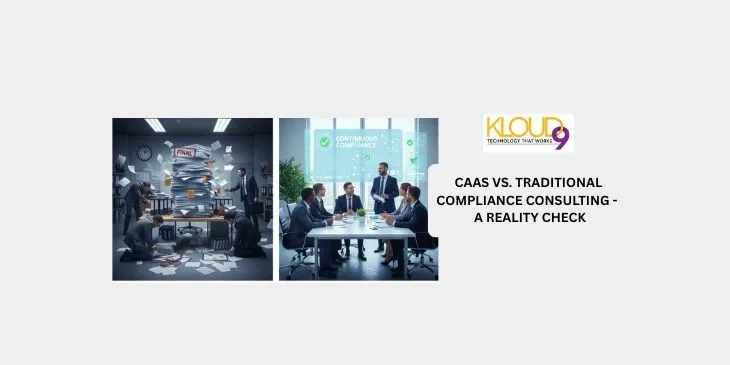
If you’ve ever worked through a compliance project, you already know how it usually goes.
A consultant shows up. Meetings happen. Documents get reviewed. Everyone works hard for a few weeks or months. Then the final report is delivered, hands are shaken, and life goes back to normal.
Until the next audit panic.
That cycle is precisely why more companies are starting to ask a simple question. Is the traditional way really working anymore? Or is there a better option?
That’s where Compliance as a Service, or CaaS, enters the conversation.
Let’s break this down honestly. No buzzwords. No hype. Just what actually happens in the real world.
How Traditional Compliance Consulting Usually Works
Traditional compliance consulting is project-based. You hire experts to help you prepare for an audit, meet a regulation, or fix a specific gap.
They’re often very knowledgeable. They know the frameworks. They understand what auditors want to see. And they can be incredibly helpful in the moment.
But the relationship has a clear start and end.
Once the engagement wraps up, the responsibility shifts back to your internal team. The consultant leaves. The documentation stays. The day-to-day reality moves on.
And that’s where cracks start to form.
The Quiet Gap Nobody Talks About
Between audits, things change constantly.
People leave. New hires join. Systems get updated. Processes evolve. Vendors come and go. None of this feels dramatic in the moment, but it slowly pulls you out of alignment.
Traditional consulting doesn’t usually cover that in-between space. You’re compliant at the time of the project, but there’s no one actively watching what happens after.
So by the time the next audit rolls around, you’re back to scrambling. Again.
What CaaS Does Differently
Compliance as a Service flips that model.
Instead of treating compliance like a one-time event, it treats it like an ongoing responsibility. Someone is always paying attention and constantly checking, always adjusting.
Think of it like routine maintenance instead of emergency repairs.
There’s no big “before and after” moment. Compliance becomes part of normal operations.
That shift alone changes everything.
Stress Levels Tell the Real Story
Here’s an easy way to compare the two. Ask your team how they feel six months after an audit.
With traditional consulting, stress slowly creeps back in. People wonder if documentation is still accurate. If controls are still working. If anyone remembered to update policies after that last system change.
With CaaS, there’s more calm. Not perfection. Just confidence that someone is keeping an eye on things.
And confidence matters more than most companies realize.
Ownership Feels Different
Traditional consulting often leaves teams holding a thick binder or shared folder full of documents they didn’t write and don’t fully understand.
When something changes, people hesitate. “Should we update this?” “Will this affect compliance?” “Do we need to call the consultant again?”
With CaaS, compliance feels shared. There’s guidance, not just deliverables. Teams aren’t guessing. They’re supported.
That changes how people behave day to day.
Speed vs. Sustainability
Traditional consulting can move fast. That’s one of its strengths. If you have a deadline and need help now, it can be the right choice.
But speed doesn’t always equal sustainability.
CaaS moves at a steadier pace. Small updates. Regular reviews. Ongoing conversations. It’s not about rushing to the finish line. It’s about staying on the track.
Over time, that steadiness reduces mistakes and burnout.
Audits Feel Very Different
This is where the contrast becomes obvious.
With traditional consulting, audits often feel like tests. Teams gather evidence. They hope everything lines up. They brace for findings.
With CaaS, audits feel more like check-ins. Much of the evidence already exists. Gaps, if any, are smaller. Surprises are rare.
Auditors notice that difference too.
Cost Looks Different Over Time
At first glance, traditional consulting can seem cheaper. You pay for a project, get results, and move on.
But repeat that project every year or two, and the costs add up. Not just financially, but in time, stress, and disruption.
CaaS spreads costs over time. It’s predictable. Easier to budget. And often less expensive in the long run because you’re not constantly fixing avoidable problems.
The real savings come from fewer emergencies.
Internal Teams Benefit More Than You’d Expect
One of the biggest hidden benefits of CaaS is education.
Over time, internal teams learn how compliance works. They understand why controls exist. They know how to document changes properly.
With traditional consulting, that knowledge often stays with the consultant.
With CaaS, it stays in your organization.
That’s a big deal.
Flexibility in a Changing World
Regulations change. Businesses change faster.
Traditional consulting can feel reactive. Something changes; you call for help. Another project starts.
CaaS is built for change. Updates are expected. Adjustments are normal. Compliance evolves alongside the business instead of lagging behind it.
That flexibility reduces friction when growth happens.
Not an Either-Or for Everyone
Traditional consulting still has a place.
Suppose you’re facing a major regulatory shift if you’re dealing with a one-time remediation. Suppose you need deep expertise fast. Traditional consulting can be the right move.
CaaS shines when compliance is ongoing, complex, and tied closely to daily operations.
Some organizations even use both. Consulting for big milestones. CaaS for everything in between.
The Human Factor Matters
At the end of the day, compliance is handled by people.
When people feel supported, they care more. They pay attention. They speak up when something feels off.
CaaS encourages that mindset. Traditional consulting, by nature, is more transactional.
Neither approach is wrong. They’re just built for different realities.
What the “Reality Check” Really Is
The real question isn’t which model sounds better. Which one matches how your business actually operates?
If compliance only matters right before an audit, traditional consulting may be enough.
If compliance needs to stay solid all year long, across constant change, CaaS usually makes more sense.
Final Thoughts
CaaS vs traditional compliance consulting isn’t about trends. It’s about fit.
Traditional consulting delivers expertise at key moments. CaaS delivers consistency every day.
One is a sprint. The other is a steady walk.
Knowing the difference helps organizations stop reacting and start managing compliance in a way that actually works.