A few years ago, a friend of mine was running a fast-growing logistics company. Everything was going great until their server crashed on a Monday morning. No shipments. No emails. Just stress.
Their tiny internal IT team was overwhelmed, and that’s when the big question came up:
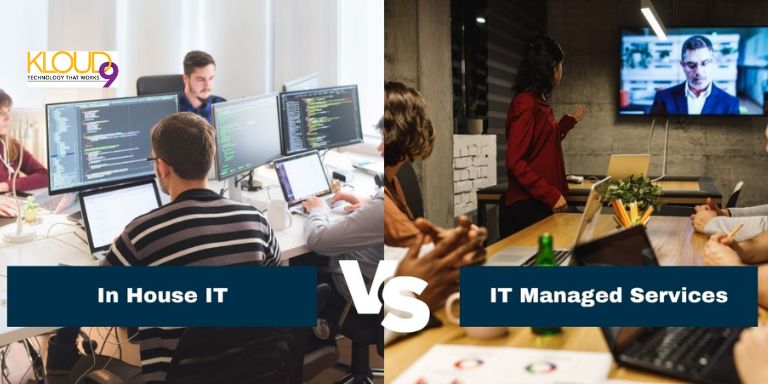
Should we keep building an in-house IT team or bring in managed IT services?
If you’re growing and starting to feel that same pressure, you’re not alone. This decision hits almost every scaling business at some point. And the right choice depends less on trends and more on where your company is right now.
First, What's the Real Difference?
Before we compare, let’s make sure we’re talking about the same things.
In-house IT means you hire your own employees to handle your systems, security, support, and infrastructure. They’re on your payroll and work only for your company.
Managed IT services means you partner with an outside provider that remotely monitors, maintains, and supports your technology for a predictable monthly fee.
Both can work well. But they solve different problems.
Where In-House IT Still Makes Sense
Let’s be fair. In-house IT isn’t outdated. In some situations, it’s precisely what a business needs.
Companies often prefer internal teams when they want full control and constant on-site presence. If your operations are highly specialized or heavily regulated, having someone physically in the building every day can be valuable.
Advantages of In-House IT
Having your own IT staff gives you direct oversight and immediate access. That can feel reassuring, especially early on.
- Complete control over systems and priorities: Your team focuses only on your business needs.
- Deep familiarity with your environment: Internal staff often know the quirks of your systems inside and out.
- Instant on-site support: No waiting for a technician to arrive.
That said, what works at 20 employees often strains at 75 and really stretches at 150.
The Hidden Challenges of Building an Internal IT Team
Here’s the part many growing companies underestimate.
Hiring a single IT person rarely solves the entire problem. Modern technology environments are complex. Security, cloud, networking, compliance, and backups. It’s a lot.
I’ve seen businesses hire a single “IT guy” and expect them to handle everything. It works for a while. Then burnout hits. Or something slips through the cracks.
Why Many Growing Businesses Move to Managed IT Services
Managed IT services are built for scale. Instead of relying on one or two internal hires, you’re essentially getting access to a whole team of specialists.
Think of it like this: instead of one general practitioner, you suddenly have a whole medical group on call.
For growing companies, that shift can be massive.
Benefits of Managed IT Services
When a business employs a managed provider, it eliminates much of the operational stress around technology.
- Predictable monthly costs: You’ll know exactly how much you will spend at the end of the month and not be surprised by repair bills or new hires.
- Access to a full bench of experts: A managed service comes with cloud engineers, security specialists, network professionals, and more.
- 24/7 monitoring and support: The service provider will monitor your systems all around the clock and provide support when needed.
- Stronger cybersecurity posture: You will enjoy stronger security and modern threat protection.
Cost Reality: It’s Not Just Salary vs. Subscription
At first glance, in-house IT can seem cheaper. One salary feels straightforward.
But when companies run the whole numbers, the picture often changes.
What Internal IT Really Costs
- Salary
- Benefits
- Payroll taxes
- Training and certifications
- Backup coverage
- Tools and software
- Recruiting costs if someone leaves
Now multiply that by the fact that most environments really need more than one skill set.
Managed services bundle many of those costs into one predictable fee. That’s why many CFOs start leaning in that direction as the company grows.
Control vs. Coverage: The Trade-Off That Matters
If we strip this decision down to its core, most businesses are really choosing between two things:
Maximum control (in-house) vs. maximum coverage and scalability (managed services)
Neither is universally better. It depends on your priorities.
Choose in-house IT if:
- You require constant physical presence.
- Your environment is highly specialized.
- You have the budget to build a whole team.
- You want tight internal control
Choose managed IT services if:
- You’re scaling quickly.
- You want predictable costs.
- Cybersecurity keeps you up at night.
- Your current IT support feels stretched.
- You prefer proactive maintenance over reactive fixes.
The Hybrid Model: What Many Smart Companies Do
Here’s something you don’t hear enough about.
Many growing businesses don’t pick one or the other. They blend both.
For example:
- Keep a minor internal IT coordinator
- Partner with a managed provider for monitoring, security, and heavy lifting
This approach gives you the familiarity of someone in-house with the depth of an external team.
I’ve seen this work exceptionally well for companies with 50–300 employees.
Signs You’ve Outgrown Your Current IT Setup
If you’re on the fence, watch for these red flags. They usually mean it’s time to rethink your approach.
- IT tickets are piling up.
- Security concerns are increasing.
- Your team is always in reactive mode.
- Downtime is becoming more expensive.
- You’re planning major growth or cloud moves
- Leadership is worried about compliance risks.
When these start stacking together, the conversation usually shifts from "if" to "when."
Conclusion
There isn’t a one-size-fits-all answer here. Both in-house IT and managed IT services can work well when matched to the right stage of growth.
But here’s the honest pattern many advisors see:
- Tiny companies often start with ad-hoc or part-time IT.
- Growing companies lean toward managed services for scale and security
- Large enterprises often build robust internal teams (sometimes with managed support layered in)
If your business is growing fast and technology headaches are multiplying, it may be time to explore at least what a managed model could look like.
Because the goal isn’t just keeping systems running.
It’s about making sure your technology quietly supports your growth rather than slowing it down.